News Update :

Search This Blog


Business

More...

Entertainment

More...

Sports

More...

Health Corner

More...
Showing posts with label Samsung. Show all posts

Samsung Set For Another Quarter Of Record Profits As HTC Falters

Saturday, 5 October 2013

Samsung has impressed analysts and investors with its latest guidance for operating profit in the third-quarter, saying it expects to have earned between 9.9 trillion won and 10.3 trillion won ($9.2 billion and $9.6 billion). That’s up from 8.06 trillion won last year and marks another record performance in operating profit. It had posted an operating profit of $7 billion in the second quarter of 2013.

Samsung derives the majority of its earnings from making and shipping smartphones, and one of its main challenges has been in competing against cheaper smartphone vendors in China.

Yet the faltering profits of HTC, a leading smartphone maker from Taiwan, will probably give Samsung some more breathing room. HTC also revealed today that it had lost 2.97 billion Taiwan dollars (101 million) in the third quarter, marking its first-ever quarterly loss.

Bernstein Research analyst Mark Newman said that till now, investors have been skeptical of Samsung’s ability to maintain its profit growth because the business for selling smartphones has become increasingly saturated, particularly in markets like the U.S. and Western Europe.

“These fears were proven wrong today,” Newman said. “We continue to believe that Samsung’s diversity of profit streams plus strength and scale in all price tiers of smartphones helps them to continue to grow profits.”

Live: National squash player Deepika Pallikal shows off Galaxy Gear

Tuesday, 17 September 2013

1.26 pm: A day in the life of Deepika Pallikal with Galaxy Gear
Galaxy Gear has just got squash player Deepika Pallikal to demonstrate the Galaxy Gear and we are all promptly subjected to a video of her showing off ‘a day in the life of Deepika Pallikal’ with the Galaxy Grand. She is now talking effusively about how easy the device was to use, how fashionable it is, and how as an athlete she loved using the pedometer.

1.19 pm: Samsung now showing off the Galaxy Gear
We’re now getting a hands on demo of the Galaxy Grand smartwatch. We’re looking at how you can swipe through and out of different apps. The features so far are very interesting, but we’re afraid this has to be said. The presentation is really boring.

The only lively thing on stage so far are the ads.

1.00 pm Samsung’s product head Manu Sharma shows off the SPen for the Galaxy Note 3
We’re getting the same demo that we saw at IFA. Sharma is talking about the ‘Dot, Circle, Box’ features for the SPen on the Galaxy Note 3. The Air Command demo is here. Note 3′s Air Command lets users do 5 different things. Action memo, scrapbook, screen write, S finder and Pen window are the features of the Air Command.

Action memo lets users open a memo such as number or email you’ve jotted down on the phone. The Action memo will let you call directly from the number you’ve jotted down. You can also save the number, send SMS, add an email address, etc.

Scrapbook: Users can use the pen to draw a circle around a link and then add it to a particular Scrapbook. Users can create various kinds of Scrapbooks with various layouts. You can also create more than one category.

Samsung now has two designers Gauri and Nainika on stage talking about inspiring and useful the Note 3 is.

He’s also talked about the SNote which can now be synced with PCs. Followed by Another video on the Note 3.

Multi-Windows Users can now run the same app in two Windows. For instance you can run Gmail twice in the same Multitask Window. Or run a Chat app twice on the same Multitask Windows.

12.55 pm Galaxy Note 10.1 edition tablet will come to India by October
Samsung says it will hold another event for the same. Meanwhile the Vodafone users will get 2GB data free two months when they buy the Note 3 smartphone. Samsung still hasn’t confirmed the Note 3 priced. Some sort of Samsung show going to start soon with detail demos of both devices. People would actually want a price confirmation now.

12.50 pm: Samsung Galaxy Gear is also officially launched
Samsung is calling it the wearable category. Video of Galaxy Gear on stage. Vineet Taneja confirms that the Gear will be launched along with the Note 3 in India. The Galaxy Gear and Note 3 will be available for sale in India on 25 September.

Samsung is also making 100 of these devices available for consumer demos in New Delhi, Mumbai and Bengaluru.

12.45 pm Note 3′s improved S Pen
Now get ready for the Air Command demo. Samsung has improved the S Pen with more features for multi-tasking. Samsung’s Galaxy Note 3 also comes with better security via Samsung Knox which the company says works for companies that have the BYOD policy. (Bring your own device)

12.41 pm: Galaxy Note is a new product category, says Taneja
Country Head,, Mobile and Digital Imaging at Samsung Electronics Vineet Taneja is talking us throught the Galaxy Note. But if it’s all sounding a little familiar, that’s because it is. He’s talking about how Samsung created a new product category with the Note series.” Note 3 weighs at 163 gms but Samsung has kept the width of the phone same as the Note 2. The Note 3 has a 5.7-inch full HD screen.

It’s now video time. We’ve already seen these ones at IFA 2013. Note 3′s price is causing a stir on Twitter as well.
12.30 pm Galaxy Gear and Note 3 price details Samsung Galaxy Note 3 is priced at Rs 49,990. Wow that’s more expensive than the current iPhone 5. Would you considering buying the Note 3 or do you think it is too-high a price? The Galaxy Gear is priced at Rs 22,990. 12.25 pm Price of Galaxy Note 3 confirmed According to CNBC-Awaaz‘s Ankit Vengurlekar, the price of the smartphone has been confirmed. He tweeted out that Samsung Galaxy Note 3 launches for 49,990 rupees and Galaxy Gear Smart Watch is priced at 22,990 bucks.

12.20 pm Galaxy Gear smartwatch The Galaxy Gear smartwatch is launching as well. Remember that this currently only works with the Note 3 though Samsung is trying to make it compatible with other Android phones. Obviously the Galaxy range of Androids will get first preference. Also Samsung could launch two new smartphones which are priced under Rs 15,000. Meanwhile the live webcast doesn’t seem to be working. 12.15 pm: Price, price A lot of people on Twitter talking about what the price of the Galaxy Note 3 will be like. Someone on our sister site tech2 commented that the price is Rs 48,500. Now while we don’t we know if that is true, Samsung’s Galaxy Note 3 won’t be less than Rs 45,000. The Galaxy Note 2 was launch in India at a price of Rs 39,990. 12.10 pm: Twitter buzz around Note 3 launch The Note 3 launch is all set to begin New Delhi. Twitter folks are excited about the launch. Here are some tweets of eager fans who are waiting to upgrade to Note 3. Are you planning to switch to Note 3 as well or will the high price be a letdown? Let us know in comments or tweet out to us @FirstpostTech.


Samsung is all set to launch the Galaxy Note 3 and Galaxy Gear smartwatch in India today. The company is running a live webcast of the launch as well which you can catch here. We will be live-blogging the event as well.

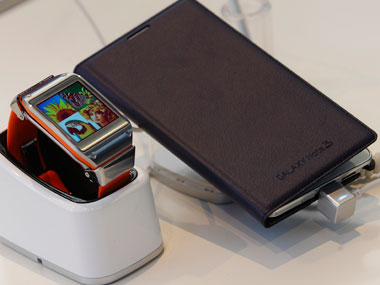
Samsung Galaxy Gear and Galaxy Note 3 in this smartphone. Reuters The launch event will begin at 12.15 pm. While the device will be showcased in India today, it will only hit the stores on 25 September. Samsung has also opened up pre-orders for the Samsung Galaxy Note 3 and the Galaxy Gear smartwatch.

Samsung Galaxy Gear and Galaxy Note 3 in this smartphone. Reuters

Users can pay an advance payment of Rs 2,000 for pre-booking the device. Samsung is also offering Galaxy Note 3 with the Galaxy Gear smartwatch at the same pre-booking price. Of course, the actual price of both devices is going to be much higher than Rs 2000.
The Note 3 could be priced higher than Rs 45,000 and closer to Rs 50,000. The Galaxy Gear smartwatch which was launched for $299 could cost close to Rs 19,000 in India or it could be priced higher as well.

Samsung and Qualcomm fail to launch the smartwatch revolution

Saturday, 7 September 2013

Two new smartwatches are really relics from yesterday, not a glimpse of tomorrow

Everybody's been waiting for the smartwatch revolution to begin, and for major companies (other than Sony) to unveil their long-awaited offerings in this new era of mobility.

Samsung announced this week their Galaxy Gear smartwatch. Qualcomm also announced a smartwatch called the Toq.

Press and pundits are treating these new entrants as the beginning of the revolution. But they're not. They're throwback, unserious relics from the past. They will both fail in the market. And they don't represent the awesome smartwatch lineup to come.

Samsung and Qualcomm aren't really trying
Smartwatches are nothing new. They've been around for years. In fact, many of these older smartwatches have been capable of playing videos, taking pictures and even making phone calls without connecting through a smartphone.

Despite some appealing features, these watches never caught on as mainstream devices for a variety of reasons. But the main reason is that they were just too big.

No matter what a smartwatch can do, no matter how much technology you pack into it, only a tiny minority of highly motivated geeks are going to walk around with a giant, dorky gadget lashed to their wrists.

But with Bluetooth Low Energy, lower-power screens, curved glass, curved batteries, better batteries and a lot of help from Moore's Law, we're finally at the point where smartwatches can be small enough and useful enough for mainstream acceptance.

These new technology developments are why the smartwatch revolution is coming now and why most major consumer electronics companies are finally getting into the smartphone business. For the first time, a smartwatch can be acceptably small. Small enough for a business man or woman to wear without looking absurd. Small enough for companies to sell into a mainstream consumer market.

The other reasons why the smartphone revolution is happening now is the convergence of several trends, including the rise of notifications, the quantified self and fitness computer movements and the existence of voice-based artificial intelligence virtual assistants like Siri and Google Now (You don't need a big screen for search results when a virtual assistant speaks the answer).

That's why it's forehead-slappingly dumb for both Samsung and Qualcomm to come out with smartwatches that are at least as big as the huge watches that failed because of their size, don't have quantified self sensors and don't have voice-based virtual assistant capabilities. (Pictures on this blog do a good job showing the size of the watch.)

The Samsung Galaxy Gear is not part of the new smartphone movement, and it doesn't employ the elements of that movement. It's just a big dorky smartwatch that suffers from the same fatal flaws that have plagued the category for years.

In fact, Samsung isn't even trying to ignite, define or dominate the coming smartwatch revolution. Their Galaxy Gear watch is just an add-on gimmick for a tiny range of high-end Samsung phones and tablets.

The Galaxy Gear displays notifications from a phone or a tablet via Bluetooth, plays music, shows various watch faces, runs apps, takes photos and video and functions as a speakerphone and phone dialer. It's got a 1.63-inch Super AMOLED touch display at a resolution of 320 x 320 and a 1.9-megapixel camera built into the strap facing away from the 12-hand position of the clock. It's powered by a single-core 800MHz Exynos processor, has 512 MB of memory, 4 GB of storage and a 315-milliamp-hour lithium-ion battery. It comes in six colors. Out of the box, the Galaxy Gear has a few apps, with up to 70 to choose from in its store. It's scheduled to become available in the U.S. in October after being launched abroad Sept. 24.

Today, the Samsung Galaxy Gear, which requires a Bluetooth connection to a smartphone or tablet in order to function right, works with exactly zero phones -- literally incompatible with every phone ever sold.

When the Galaxy Gear ships, a giant new Samsung phone called the Galaxy Note 3 will also ship and support the watch. Later, the Galaxy S4 and Galaxy S III are expected to support the watch when Samsung releases a software update, probably in October.

Among this tiny minority of Android smartphone users, Samsung will have to find males who are not professionals (it's too big for women or for business wear), who are among the minority who want a smartwatch at all, are willing to pay $300 for it, don't want biometric fitness features, can put up with its lousy battery life and don't prefer a smartwatch from the dozens of other companies that will be selling smartwatches compatible with many phone brands.

This watch has a market of a few thousand people, tops.

Qualcomm is trying even less than Samsung is.

Qualcomm's Toq (pronounced "talk") is also way too big and also $300. At least it can last a few days on a charge and work with a majority of newer Android smartphones and later iPhones.

In fact, controlling the phone is the main focus of Toq, rather than running apps on its own. The interface provides basic controls for navigation notifications and performing basic smartphone functions, like playing music

The Toq's battery is built into the watch band clasp.

But let's be clear, the Qualcomm Toq is not intended to be a serious contender for the future of smartphones. It's more of a proof-of-concept for Qualcomm's technology, especially its sunlight-readable, low-power, color mirasol display technology. The company has said it expects to sell tens of thousands of units only and would prefer that other companies make smartwatches with Qualcomm parts.

But don't worry: The revolution is coming
Despite Samsung's and Qualcomm's poor efforts in smartwatches, we're going to see a flood of devices coming in the next year. We're likely to see smartwatches from Acer, Apple, Dell, Foxconn, Google, Intel, LG, Microsoft and Toshiba. We'll also see startups shipping watches, including AGENT, Androidly, EmoPulse, Hyetis, Kreyos, MyKronoz, Neptune, Omate, PHTL, Rearden, Sonostar and Vachen. And we have already seen smartwatches ship from the likes of Cookoo, GEAK, I'm Watch, Pebble, Sony and others.

Some of these are likely to hit the right combination of size, features, performance and price that will knock the likes of Samsung's giant Galaxy Gear right out of contention.

In fact, Sony's SmartWatch 2 is already vastly superior to the Galaxy Gear in key respects. It's smaller, cheaper, looks more professional, has longer battery life and is far more widely compatible.

The Samsung Galaxy Gear and Qualcomm Toq are not the smartwatch revolution you've been waiting for.

A few hardcore geeks will buy them. But the rest of us will wait until the real revolution starts -- when smartwatches are small and sleek enough, low cost, functional and useful enough for everybody to wear.

Samsung and Sony - searching for a new frontier

Friday, 6 September 2013

Do you get excited by yet another new touchscreen smartphone? Does the latest all-singing all-dancing tablet grab your attention?

Unless you are a dedicated technophile, I imagine the answer is no. And that is why the major technology firms are now on the hunt for new kinds of gadget to whet the jaded appetites of consumers.

As Berlin's IFA consumer electronics show gets under way, we have already seen two firms, Samsung and Sony, trying to stake out new territory with products that look different.

By unveiling the Samsung Gear smartwatch in a vast arena with an orchestra and a live link to New York's Times Square, the Korean firm was not going for a low-key debut for its new product category.

There are some cool things about the watch - raise it to your ear and it knows you want to make a call, swipe across its face and it is ready to take a photo from the camera in the strap. A clutch of well-known apps are already on board, and leading developers are preparing more.

But after the initial "Ooh"s and "Aah"s from the audience, serious doubts quickly emerged. The Gear is not a stand-alone device, but a smartphone accessory - and one that right now works with only one phone, Samsung's Galaxy Note. So, an expensive toy, and one that will need charging every day.

Beyond a minority of tech enthusiasts, it is hard to see a huge market for this product, especially when other smartwatches which work with a whole range of phones are already out there. But Samsung will be happy to have beaten Apple to the punch - its iWatch may end up defining this new market, but at the moment it is no more than a rumour.

Sony, with a somewhat less lavish press event, still wanted to give the world something new. Its offering - stand-alone lenses that connect to a smartphone via wifi - seeks to redefine the mobile photography experience. The idea is that they add some of the quality of a digital SLR camera to the convenience of smartphone photography.

Sony's engineering prowess is in no doubt, and the demo in Berlin looked very impressive. But how many people are going to want to carry another quite bulky product with them along with their smartphone? This looks like another product hunting down an audience that just might not be there.

Under its new leader, Kazuo Hirai, Sony seems to have got some of its mojo back, but it is still searching for the new Walkman - a product that will redefine what we expect from technology.

Sony and Samsung also launched impressive new phones - the Xperia Z1 and the latest version of the Phablet, the Galaxy Note 3. But, with profit margins from smartphones now being squeezed, the tech giants are restlessly scanning the horizon for the next big thing. So far, it has yet to emerge in Berlin, but I will let you know if I spot it.

Samsung shows off massive 98-inch Ultra HD TV, teases Ultra HD OLED TV

Thursday, 5 September 2013

Samsung’s “unpacked” press conference yesterday at IFA 2013 was just the start for the South Korean company. Today, Samsung showed off a massive 98-inch Ultra HDTV, hinted at an even larger 110-inch model and teased an Ultra HD OLED TV as well. 

Samsung said very little about its 98-inch S9 Ultra HD TV, instead letting the set’s scale speak for itself. Essentially, the display looks Samsung 98 and 110 inch s9 UHDexactly like its smaller, 85-inch sibling, complete with integrated “timeless gallery” frame. Like the 85-inch S9, we can expect Samsung to pack the TV with all the bells and whistles. Samsung also addressed the lack of broadcast standard, explaining that, once a standard is settled on, owners will be able to update their Ultra HD TVs through a one-connect box exchange program.


If Samsung was light on details regarding its latest LED-based Ultra HD televisions, it was downright secretive about its plans to bring an OLED-based Ultra HD television to market. Samsung did little more than to suggest such a TV did exist and then encourage conference-goers to come check out it out at its booth. Since the company didn’t show off the TV at the press conference, we can safely assume the TV is very much in the prototype stage at this point, and not something Samsung wants to move around a whole lot. We expect to hear a lot more about Samsung’s Ultra HD OLED at CES 2014. 

Samsung aims to redefine future of smartwatches

Samsung's new Galaxy Gear smartwatch is on the cutting edge of a growing trend of wearable technology.

When it comes to smartwatches, the future ain't what it used to be. Can Samsung change that?

A high-tech watch, such as the two-way radio and TV wristwatches used by Dick Tracy in the comics more than four decades ago, was among those futuristic devices foreshadowed in science fiction. But along the way, the smartphone became all-powerful.

Now Samsung, already a major smartphone power, has introduced its new Galaxy Gear smartwatch with hopes of making the watch a must-wear device again.

The tech giant revealed the watch and its new Note 3 big-screen smartphone Wednesday at the IFA electronics show in Berlin. Black-jacketed bouncers checked credentials of a few hundred journalists and industry affiliates who piled into the Tempodrom, a high-ceiling roundhouse auditorium near central Berlin.

Chamber music played before the new products were revealed on a really big screen stretched about 180 degrees around the center of the room. On stage, Samsung research team leader Pranav Mistry deemed the Galaxy Gear as "something out of science fiction .... (that) reinvents a centuries old product."

Perhaps, but it has some hurdles to surmount, says futurist Paul Saffo, who teaches long-range forecasting at Stanford University.

"At the moment, the only people who wear things on their wrist are people old enough to have an AARP card. Students look at wristwatches today the same way that their grandparents looked at pocket watches in the middle of the last century, as an unbelievably old-fashioned thing," Saffo says. "But that is about to change."

Samsung's Galaxy Gear, due to hit the market later this month for a reported $299, will let wearers access texts, e-mails, news, weather and music from their Samsung portable devices. That's similar to what you can do with the Pebble watch, released earlier this year. And the Galaxy Gear responds to voice commands as does the Martian Watch, released just over two months ago.

Sony has its own SmartWatch 2 out this month, and analysts expect Apple and Google to chime in on the category. Smartwatches fit into a growing wearable device market that research firm Gartner estimates will hit $10 billion by 2015.


Whether Samsung's device becomes a mainstream winner remains to be seen, Saffo says. But eventually, "A whole new generation is about to rediscover that a wrist is a useful place to put a device," he says.

Not all consumers will think it's time to rejoin the watch-wearing crowd, despite the new devices' features, says P.J. McNealy of Digital World Research.

"You already have multiple things you can check the time on," McNealy says. "Your smartphone, your iPad, your PC and the wall. Having another device such as a watch just means it's a more crowded field."

There will be those who like the idea of a smaller screen to use beyond the progressively larger options provided by phones, tablets and laptops, he says. "A 2- or 3-inch smartwatch screen is filling out the product portfolio."

Samsung is smart to tout how the Galaxy Gear can help users get more out of their larger-display devices, says Gartner research director Angela McIntyre.

"These larger devices are bulky to take in and out of bags to frequently check calls and messages," she says. "Smartwatches are accessories to smartphones and phablets."

However, McNealy notes, smartwatches have failed before. In 2004, Fossil and others teamed with Microsoft on new SPOT (Smart Personal Objects Technology) watches that displayed news, weather and messages. But time ran out on them four years later.

At the time, few consumers were ticked off.

Qualcomm outs its Toq smartwatch in bid to rival Samsung Galaxy Gear

CHIP DESIGNER Qualcomm has thrown its hat into the smartwatch ring with the announcement of its Toq smartwatch.

Toq, which we understand is pronounced "talk" as opposed to "tock", which is a noise that clocks make, is Qualcomm branded and will go on sale sometime this year.

Qualcomm, which must deal with rival watches from firms including Samsung, Sony and Apple, is using compelling words like "seamless" to introduce its bridge between your wrist and your pocket.

"Toq's always on, always connected, always visible wearable technology gives you a 'Digital 6th Sense,' telling you what you need to know, when you need to know it, with just a glance at your wrist or a whisper in your ear. Toq is a showcase for the benefits of the Mirasol display, Wipower LE and stereo Bluetooth technologies and highlights the experience that the wearable category can provide," said Dr Paul Jacobs, chairman and CEO of Qualcomm.


"Toq not only represents a long history of technological innovation for Qualcomm, but it also demonstrates our commitment to delivering the breakthrough technologies that redefine the ways we interact with each other and the world around us."

Qualcomm enthused about its features, saying that it has a long battery life measured in days and hooks up to a smartphone with ease. Its second screen features will let users look at messages, reminders and other notifications that otherwise end up in their pockets. Charging is done wirelessly through a dock.
A "Premium Audio Edition" is pitched at people that like wireless headsets and handsfree calls.

At launch, the Toq smartwatch will be compatible with Android 4.0.3 and above. Pricing has not been revealed yet. µ

Samsung and Sony - searching for a new frontier

Do you get excited by yet another new touchscreen smartphone? Does the latest all-singing all-dancing tablet grab your attention?

Unless you are a dedicated technophile, I imagine the answer is no. And that is why the major technology firms are now on the hunt for new kinds of gadget to whet the jaded appetites of consumers.

As Berlin's IFA consumer electronics show gets under way, we have already seen two firms, Samsung and Sony, trying to stake out new territory with products that look different.

By unveiling the Samsung Gear smartwatch in a vast arena with an orchestra and a live link to New York's Times Square, the Korean firm was not going for a low-key debut for its new product category.


There are some cool things about the watch - raise it to your ear and it knows you want to make a call, swipe across its face and it is ready to take a photo from the camera in the strap. A clutch of well-known apps are already on board, and leading developers are preparing more.


But after the initial "Ooh"s and "Aah"s from the audience, serious doubts quickly emerged. The Gear is not a stand-alone device, but a smartphone accessory - and one that right now works with only one phone, Samsung's Galaxy Note. So, an expensive toy, and one that will need charging every day.


Beyond a minority of tech enthusiasts, it is hard to see a huge market for this product, especially when other smartwatches which work with a whole range of phones are already out there. But Samsung will be happy to have beaten Apple to the punch - its iWatch may end up defining this new market, but at the moment it is no more than a rumour.


Sony, with a somewhat less lavish press event, still wanted to give the world something new. Its offering - stand-alone lenses that connect to a smartphone via wifi - seeks to redefine the mobile photography experience. The idea is that they add some of the quality of a digital SLR camera to the convenience of smartphone photography.

Sony's engineering prowess is in no doubt, and the demo in Berlin looked very impressive. But how many people are going to want to carry another quite bulky product with them along with their smartphone? This looks like another product hunting down an audience that just might not be there.

Under its new leader, Kazuo Hirai, Sony seems to have got some of its mojo back, but it is still searching for the new Walkman - a product that will redefine what we expect from technology.

Sony and Samsung also launched impressive new phones - the Xperia Z1 and the latest version of the Phablet, the Galaxy Note 3. But, with profit margins from smartphones now being squeezed, the tech giants are restlessly scanning the horizon for the next big thing. So far, it has yet to emerge in Berlin, but I will let you know if I spot it.

After Sony and Samsung, Qualcomm brings out its Toq smartwatch

San Diego: Qualcomm Inc has unveiled the Toq, a smartwatch that can play music and handle phone calls and messages, and said it would start selling the device in the fourth quarter, marking the chipmaker's entry into the emerging arena of wearable computing.

The company, which dominates the global market for applications processors for smartphones and tablets, introduced the device on Wednesday in a bid to showcase its own technology to manufacturers as Samsung Electronics Co Ltd unveiled its own much-anticipated "Galaxy Gear" in Berlin.

The Korean company's gadget also performs basic functions like calls, photos and messaging in concert with a smartphone.

Apple Inc and Google Inc are also widely believed to be working on "wearables" such as wrist-worn devices, in what analysts expect to be the next phase of the mobile communications boom. The exploration of such wearable-computing devices has accelerated in recent years as smartphone growth tapers off.

Qualcomm is using the watch, which works as a second display for a smartphone, to promote proprietary features including a low-power always-on display, wireless charging and stereo Bluetooth audio.


"We are in conversation with partners and our hope is that if we make a great product now and continue to improve it, it will make their offerings better as well," Anand Chandrasekher, Qualcomm's chief marketing officer, told Reuters at the company's annual developer event in San Diego.

Qualcomm executives said they would divulge more details on how to buy a Toq later this month, and did not specify a price. Tech blog Cnet reported it will sell for $300, similar to Samsung's $299 price tag for Gear.

The US company said its Google Android-compatible Toq will be the first smartwatch with a touch-enabled "Mirasol" color screen that can be easily be viewed in bright sunlight.

Popular Posts

U.S. News

More...

World News

More...
 

© Copyright A2Z Net Users 2011 | Design by Cinesarada | Hollywood | Bollywood | Tollywood | Kollywood.